The Moon Landing Hoax
The summer of 1969 changed the course of human history forever. The entire world watched in awe as a grainy black-and-white image flickered across television screens, showing a man descending a ladder toward an unfamiliar, powder-gray surface. That man was Neil Armstrong, commander of NASA’s Apollo 11 mission, and his words—“That’s one small step for man, one giant leap for mankind”—became immortal.
But as the decades passed, a growing number of people began to question whether that “giant leap” ever really happened. Could it all have been a lie, a Hollywood-style production meant to win the Cold War? This question sparked one of the most enduring conspiracy theories of the modern age—the Moon landing hoax debate.
The Roots of Doubt
The Moon landing took place at the height of the Cold War between the United States and the Soviet Union. Both nations were racing to demonstrate technological superiority. When America succeeded in landing men on the Moon in July 1969, it instantly outshined Soviet space achievements.
However, skepticism began almost immediately. In the 1970s, as distrust in government grew after events like the Vietnam War and Watergate, some people started wondering if NASA had staged the landing to claim victory. A few authors and filmmakers seized this doubt and built elaborate stories around it.
The 1974 self-published book We Never Went to the Moon by Bill Kaysing claimed NASA faked the entire event on a secret film set. Television documentaries and tabloid headlines followed, giving the theory a kind of cultural momentum that persists even today.
Why People Believe in the Hoax
Psychologists often point out that conspiracy theories thrive on emotion, not evidence. The Moon landing was such a monumental event that it almost felt too extraordinary to be true. Ordinary citizens could barely imagine computers small enough to guide a spacecraft or astronauts surviving the vast emptiness of space.
Moreover, the footage itself looked unreal: the eerie lighting, the slow-motion movement, and the silent landscape. To some, it resembled a movie set more than a cosmic destination. Add in Cold War secrecy and the lack of direct personal experience, and disbelief became easy to nurture.
The Most Common Claims
Over time, skeptics have raised several specific doubts. Understanding these helps separate myth from fact.
No Stars in the Photos
Critics point out that the Moon sky appears black and starless in Apollo photos. In reality, the camera settings were adjusted for the bright lunar surface, making dim stars invisible—just like city photography on Earth.
The Waving Flag
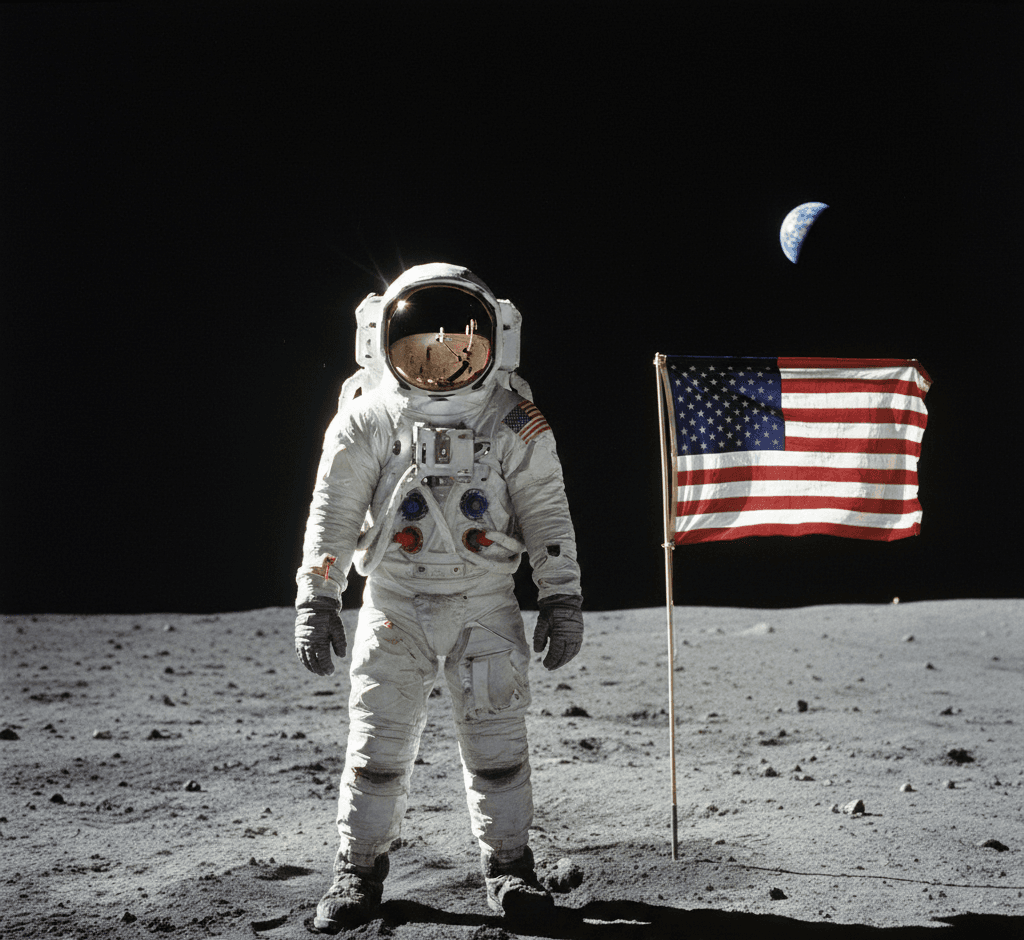
The American flag seemed to ripple in the footage. But there’s no wind on the Moon; it moved because the astronauts were twisting the pole while planting it. The flag had a horizontal rod along its top edge to keep it extended, which made it appear as if fluttering.
Multiple Light Sources
Hoax believers argue that the shadows in photos point in different directions, suggesting artificial lighting. The truth is simpler: uneven lunar terrain and a wide-angle camera lens distort shadows naturally. The sun was the only light source.
Radiation and Survival
Some claim astronauts could not have survived deadly radiation in the Van Allen belts. Yet spacecraft trajectories were carefully plotted to minimize exposure, and astronauts passed through in under an hour—receiving a dose far below harmful levels.
Studio Footage Theory
Perhaps the most famous claim is that filmmaker Stanley Kubrick helped NASA fake the footage using techniques from his film 2001: A Space Odyssey. There’s zero evidence of this, and Kubrick himself never endorsed such an idea. The real Apollo footage contains details—like the dust physics and unfiltered sunlight—that no 1960s studio could have replicated.
The Overwhelming Evidence
For every doubt, there is an abundance of proof. NASA’s missions left behind physical artifacts on the Moon that are still observable today.
Reflectors on the Lunar Surface
Apollo 11, 14, and 15 astronauts placed retroreflectors—mirror-like devices that bounce laser beams back to Earth. Scientists still use them to measure the Moon’s distance with remarkable accuracy. These instruments could not have been placed there without a human presence.
Thousands of Independent Witnesses
Over 400,000 engineers, scientists, and contractors worked on the Apollo program. The Saturn V rockets were launched before live audiences and tracked by independent observatories and foreign agencies, including the Soviets, who would have eagerly exposed a fake.
Moon Rocks and Chemical Signatures
Apollo missions brought back 382 kilograms of lunar rock and soil. These samples have been studied by scientists worldwide. Their isotopic composition and microscopic features differ completely from Earth rocks and meteorites, confirming extraterrestrial origin.
Satellite and Telescope Confirmation
In recent years, high-resolution images from NASA’s Lunar Reconnaissance Orbiter have photographed the Apollo landing sites, showing tracks, discarded equipment, and shadows of descent stages—clear, visible proof of human activity.
What Neil Armstrong Really Said
Neil Armstrong was known for his humility and restraint. After becoming the first man on the Moon, he largely avoided the spotlight, preferring quiet work in academia. Yet he occasionally addressed the conspiracy theories that followed him.
In a 2005 interview, Armstrong calmly said, “People love conspiracy theories. They are more fun than the truth sometimes. But it was real—we were there.”
He expressed disappointment that so many doubted the achievement, not because it hurt his pride, but because it disrespected the thousands of people whose dedication made it possible.
During his 1994 speech at the White House, Armstrong offered a poetic reminder of exploration’s purpose: “Mystery creates wonder, and wonder is the basis of man’s desire to understand.”
These words reflect the spirit of science—curiosity, not suspicion.
The Human Side of the Astronauts
For Armstrong, Buzz Aldrin, and Michael Collins, Apollo 11 was not an act of theater; it was an act of courage. They faced the real possibility of failure and death. President Nixon even had a prepared speech in case the crew never returned.
Armstrong later described his descent onto the lunar surface as tense and uncertain. With fuel running dangerously low, he manually piloted the lander to a safer spot. His heartbeat soared above 150 beats per minute—hardly the demeanor of someone performing in a studio.
Buzz Aldrin, too, has defended the mission’s authenticity many times. He famously punched a conspiracy theorist who accused him of lying, a raw display of frustration from a man who risked his life for humanity’s dream.
The Role of the Internet and Modern Skepticism
In the digital age, misinformation spreads faster than rockets. YouTube videos, memes, and viral posts recycle old hoax claims, giving them new life among younger audiences who may not know the original context.
However, the same internet also empowers education. Countless space scientists, engineers, and enthusiasts have used online platforms to patiently debunk myths with data, physics, and logic. The hoax theory fades each time someone takes the time to learn how space missions actually work.
Lessons from the Debate
The Moon landing hoax debate tells us more about human psychology than about spaceflight. It reveals our tension between wonder and doubt, between the need to believe in greatness and the fear of being deceived.
Neil Armstrong’s journey reminds us that truth often sounds quieter than rumor. Real science demands patience, collaboration, and precision—not drama or spectacle. The photographs, telemetry data, and moon rocks are not symbols of deception but of the heights human beings can reach when driven by curiosity and courage.
Looking Forward to the Future of Exploration
Half a century after Apollo 11, new missions are preparing to return humans to the Moon—and eventually to Mars. NASA’s Artemis program will carry astronauts, including the first woman and the next man, back to the lunar surface. The evidence of humanity’s earlier visit will be waiting there: footprints, flags, and reflectors undisturbed by time.
As these new explorers retrace the steps of Armstrong and Aldrin, the truth of 1969 will become visible again, not in grainy footage but in high-definition reality.
Conclusion
The Moon landing hoax debate endures because doubt is easy and wonder is hard. Yet every piece of scientific, photographic, and physical evidence confirms that the Apollo 11 mission truly reached the Moon. The conspiracy theory survives mostly as a cultural curiosity—a reminder of how skepticism can slip into cynicism when it ignores facts.
Neil Armstrong never tried to argue with every skeptic; he simply stood by the truth he had lived. His quiet integrity is perhaps the most convincing evidence of all.
When he stepped onto that dusty lunar surface, he carried not only the hopes of a nation but also the imagination of the entire world. The echo of his words—“one giant leap for mankind”—still rings across generations, reminding us that the truth of human achievement will always outshine the shadows of doubt.
📚 References
- “The moon landing at 50: Neil Armstrong in his own words” — YouTube video of Armstrong interview YouTube
- “Retroreflectors: From Apollo to Mars” — NASA article on laser reflectors placed on Moon NASA
- “Laser Ranging Retroreflector (LRRR)” — NASA/NSSDCA experiment description nssdc.gsfc.nasa.gov
- “Apollo 11 Image Library” — NASA’s collection of lunar surface images NASA
- “Transcript of the First Moon Landing” — APS/NASA transcript with Armstrong’s quote amphilsoc.org
- “Neil Armstrong Quotes — Official Licensing Website” — quotes from Armstrong including about landing, walking neilarmstrong.com
- “Apollo 11 Mission Overview” — NASA mission summary, launch details etc. NASA
- “Why Is the Apollo Reflector Experiment Still Operating” — article about lunar reflector experiments still in use Space
- “It Is ‘One Small Step for a Man’” — Wired article analyzing Armstrong’s “missing ‘a’” in his famous quote WIRED
- “The Apollo Experiment That Keeps on Giving” — JPL/NASA write-up on reflectors and continuing science NASA Jet Propulsion Laboratory
- “Altering Armstrong’s Quote: What Did He Really Say?” — Navy Times on the “missing ‘a’” debate Navy Times
- “The Best Interview of My Life with Neil Armstrong” — podcast interviews and Armstrong’s reflections Apple Podcasts
- “Armstrong Oral History Project Transcript” — NASA’s archive of Armstrong’s oral histories NASA