
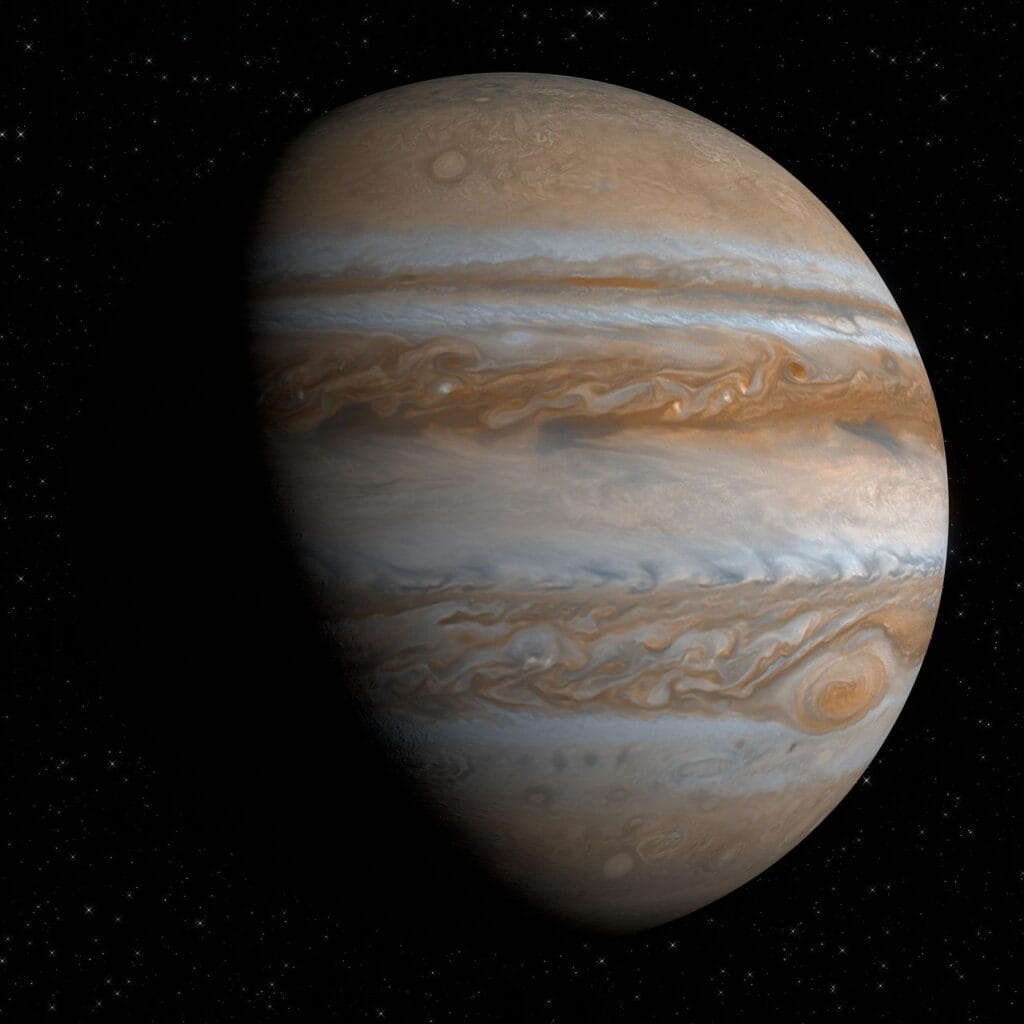
Look up on a clear night. Among the tapestry of stars, one point of light often shines brighter and steadier than the rest. To the ancients, it was the king of the gods, a wandering star named for the powerful Roman deity, Jupiter. For centuries, it was just that—a brilliant but featureless beacon in the heavens.
Then, Galileo turned his primitive telescope toward it in 1610 and forever changed our place in the universe. He didn’t see a perfect, immutable star; he saw a striped globe with four moons of its own. Our Earth was suddenly not the center of all things.
Today, we have done Galileo one better. We’ve not just looked at Jupiter; we’ve journeyed to it. robotic emissaries, bearing the names Voyager, Galileo, and Juno, have raced across the gulf of space to stare directly into the face of this giant. They have sent back data and images so profound, so stunningly detailed, that they have transformed Jupiter from a distant point of light into a living, breathing, and terrifyingly beautiful world.
The latest photos from NASA’s Juno spacecraft are more than just pictures; they are windows into the heart of a solar system giant. They show us chaos and order, violence and serenity, on a scale so vast it defies human comprehension. This article is a guided tour of those images, a journey to understand what we see when we look up close and from afar at the magnificent king of our solar system.
From Galileo’s Lens to Juno’s Camera: A History of Looking
Our visual understanding of Jupiter has evolved in leaps, each bound by technological triumph.
The Early Glimpses: After Galileo’s initial sketches of bands and moons, astronomers for centuries could only slightly improve the view. Through Earth-based telescopes, Jupiter appeared as a creamy ochre disc streaked with brownish belts and zones, with its Great Red Spot a persistent but faint smudge.
The First Pioneers: Pioneer 10 and 11. In the early 1970s, humanity shot its first close-up portraits. The Pioneer probes were the first to brave the asteroid belt and fly past Jupiter. Their primitive cameras revealed a world of complex weather, but the images were grainy, ghostlike, and left us hungry for more.
The Revolution: Voyager 1 and 2. The summer of 1979 delivered a revolution. The twin Voyager probes didn’t just fly by; they conducted a grand tour. Their higher-resolution cameras unveiled Jupiter in shocking, frenetic detail. The planet was not a serene, smooth globe. It was a churning maelstrom. The Voyagers showed us the turbulent cloud tops, the intricate structure of the Great Red Spot, and the volcanic fires of the moon Io. For the first time, Jupiter felt alive.
The Long-Term Observer: Galileo Orbiter Arriving in 1995, the Galileo spacecraft did what no other had done: it went into orbit. For eight years, it watched Jupiter change, season by season. It witnessed comet Shoemaker-Levy 9 slam into the planet’s atmosphere—a cosmic event it had a front-row seat to. It sent a probe plunging into the clouds, giving us our only direct measurements of the planet’s atmosphere before it was crushed and vaporized.
The Modern Master: Juno. To truly understand a giant, you must get close. That is the mission of Juno, which arrived at Jupiter on July 4, 2016. Unlike any orbiter before it, Juno flies pole-to-pole in a highly elliptical orbit, skimming breathtakingly close to the cloud tops before soaring far away. Its suite of instruments, including the JunoCam imager, is designed to see beneath the veil, to probe the secrets of Jupiter’s interior, aurorae, and immense magnetic field. And its pictures? They are nothing short of art.
The Masterpiece Up Close: Juno’s Revealing Eye
Juno’s primary mission is science, but its camera, JunoCam, was also conceived as a public engagement tool. The images it returns are often processed by a dedicated community of “citizen scientists,” who transform raw data into breathtaking works of art. What have these images shown us?
1. The Poles: A Realm of Unearthly Beauty
Before Juno, Jupiter’s poles were a mystery, hidden from our view. What Juno found there was unlike anything scientists had imagined. Forget the familiar stripes of the equator; the poles are a chaotic, stunning tapestry of swirling storms.
Gone are the linear belts and zones. In their place is a collection of gigantic cyclones, arranged with an almost geometric precision. The north pole is dominated by a central cyclone surrounded by eight others, each thousands of miles across. The South Pole has a similar structure with five cyclones. These storms are not merging or dissipating; they are stable, dancing around each other in a pattern we are only beginning to understand. The images, awash in ethereal blue and white tones, look less like a planet and more like a swirling van Gogh painting or a cosmic whirlpool of latte art.
2. The Cloud Tops: An Abstract Expressionist’s Canvas
As Juno swoops low over the equatorial regions, it captures the cloud tops in resolution so high you feel you could fall into them. These are not simple, smooth bands. They are a complex, layered, and deeply textured landscape.
Juno’s images reveal:
- Pervasive Turbulence: The boundaries between belts and zones are sites of incredible violence and beauty. Here, clouds shear past each other, creating intricate patterns of swirls, folds, and curls that resemble abstract art.
- Pop-Up Storms: Massive, bright white plumes of ammonia-ice crystal clouds can be seen erupting from the deeper atmosphere and punching through the upper cloud decks, indicating a powerful heat engine at work below.
- Texture and Depth: The images have a stunning three-dimensional quality. You can see the shadows cast by high-altitude clouds onto the layers below, revealing the complex vertical structure of Jupiter’s weather.
3. The Great Red Spot: The Storm of All Storms
No feature on Jupiter is more iconic than the Great Red Spot. A storm so large it could swallow Earth whole it has been raging for at least 400 years. Juno flew directly over this mammoth vortex, and its pictures are the most intimate ever taken.
Looking down into the storm, Juno revealed a complex interior. Instead of a simple red hole, the images show a labyrinth of intricate filaments, spiraling tendrils, and a palette of colors—deep reds at the core, fading to oranges and creams at the outer edges. The clouds within swirl at speeds exceeding 400 miles per hour. Juno’s data suggests the storm is deep, rooting itself hundreds of miles into the planet’s atmosphere, a profound revelation about its power and longevity.
4. The Aurorae: A Heavenly Light Show
Jupiter’s aurorae are the most powerful in the solar system, and Juno has a perfect view from its unique orbit. These are not the gentle green curtains of Earth’s poles. They are immense, raging rings of energy, larger than our entire planet, generated by Jupiter’s colossal magnetic field interacting with charged particles from the sun and its volcanic moon Io.
Juno’s ultraviolet and infrared instruments have mapped these aurorae in stunning detail, showing them as brilliant, dancing halos of light at the poles—a constant, radiant testament to the immense energetic forces at play.
The Grand Vista from Afar: Context is Everything
While Juno gives us the intimate close-up, there is immense power in the wider shot. Sometimes, to understand the majesty of Jupiter, you need to step back.
The “Pale Blue Dot” Perspective: Some of the most humbling images of Jupiter are those that include its moons. Photos from Voyager, Galileo, and Cassini (on its way to Saturn) show Jupiter not as a lonely giant, but as the center of its own miniature solar system. Seeing the icy moon Europa, with its cracked, promising shell, floating next to the massive orange globe, underscores the sheer scale of the planet and the potential for life in its orbit.
The “Family Portrait” View: Perhaps the most profound distant image is not of Jupiter alone, but of Jupiter with us. The famous “Pale Blue Dot” photo, taken by Voyager 1 from beyond Neptune’s orbit, shows Earth as a tiny, almost insignificant speck of light. But earlier on its journey, Voyager 1 turned its camera back and captured a breathtaking image: a crescent Jupiter and a crescent Earth, hanging together in the blackness of space. This single frame encapsulates the entire human journey of exploration—from that tiny dot, we built a machine that traveled to that giant world and sent back a postcard of home.
More Than Just a Pretty Picture: The Science Behind the Beauty
Every stunning image from Juno and other missions is a data point that helps solve the puzzles of Jupiter’s formation, which is key to understanding our entire solar system.
- Probing the Deep Atmosphere: By measuring Jupiter’s gravity field and microwaves radiating from its interior, Juno is helping scientists map the planet’s deep structure. We’re learning about the existence and nature of a potential core and how the interior rotates.
- Understanding the Magnetic Field: Juno’s study of Jupiter’s powerful magnetic field reveals it is both stronger and more irregular than models predicted, suggesting it is generated closer to the surface than previously thought.
- Water and Formation: Measuring the amount of water in Jupiter’s atmosphere is a primary goal. This is a key piece of evidence in the debate over how and where the planet formed, which has huge implications for the evolution of our solar system.
Conclusion: A Humbling and Inspiring Giant
The stunning NASA photos of Jupiter, both up close and from afar, do more than just advance science. They perform a deeper, more human function. They inspire awe. They force a perspective that is both humbling and empowering.
We are humbled by the sheer scale and power of this otherworldly being. A storm that lasts for centuries. A magnetic field that creates light shows dwarfs our planet. An atmosphere of chaotic beauty that operates on a level we can observe but scarcely comprehend.
Yet, we are empowered because we, a species on a pale blue dot, have conceived, built, and launched our eyes and our minds across half a billion miles of empty space to decode its secrets. We have turned a pinprick of light into a world we can know, study, and appreciate in all its terrifying grandeur.
The latest images from Juno are not the end of the story. They are the next chapter in a conversation between humanity and the cosmos that began when a curious man first pointed a telescope at the sky. They remind us that the drive to explore, to see what lies over the horizon, is what defines us at our best. And as long as that drive exists, the king of the planets will continue to reveal its secrets, one stunning photo at a time.