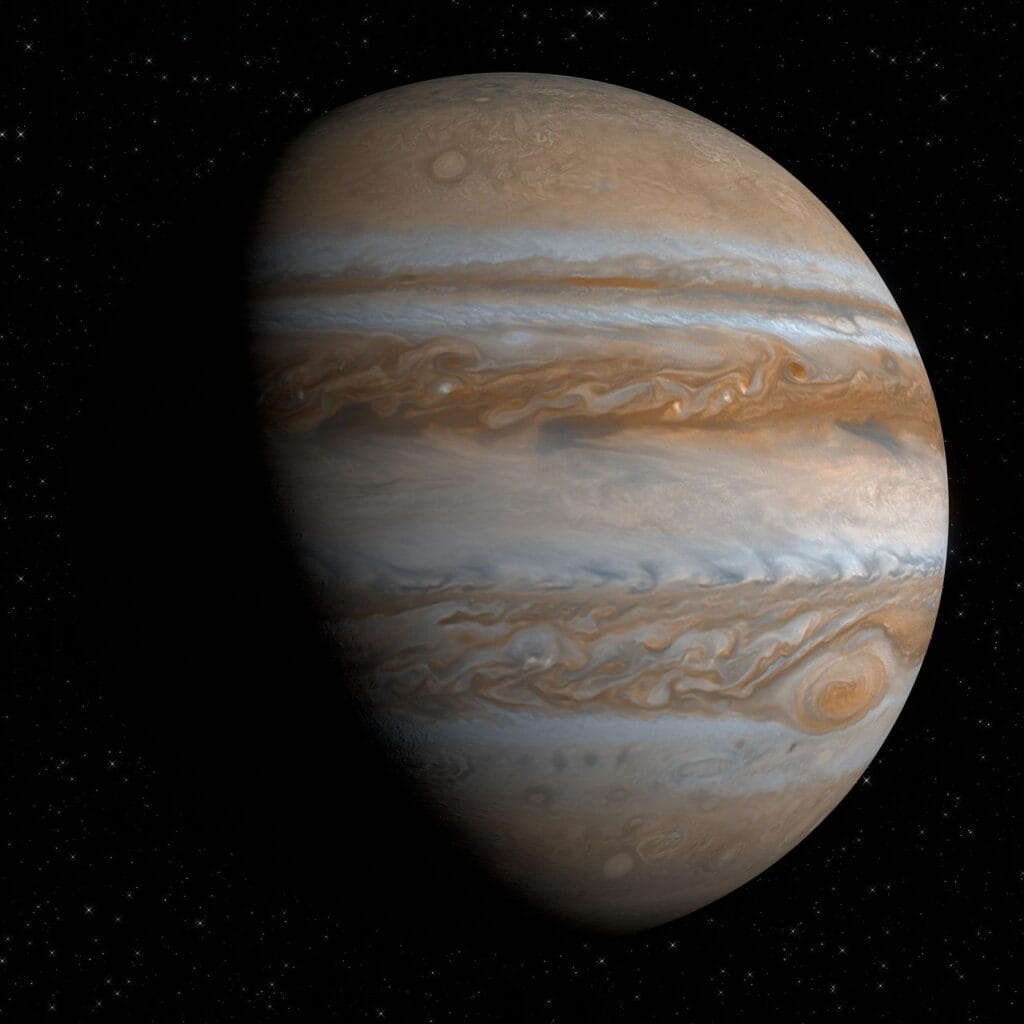

NASA’s Most Exciting Discoveries of 2025
In 2025, NASA has unveiled some of the most exciting discoveries that continue to expand our understanding of the universe. These discoveries range from new moons and interstellar objects to groundbreaking insights into the heliosphere and dwarf planets. For anyone following the latest in space exploration, NASA’s most exciting discoveries of 2025 highlight the agency’s commitment to scientific advancement and its mission to explore the cosmos.
Discovery of a New Moon Orbiting Uranus
One of the most significant discoveries in 2025 was the identification of a previously unknown moon orbiting Uranus. Astronomers using the James Webb Space Telescope spotted this small celestial body, which has been designated S/2025 U1. Measuring approximately 8–10 kilometers in diameter, this moon is situated between the orbits of Ophelia and Bianca. The discovery provides valuable insights into Uranus’ satellite system and contributes to our understanding of planetary formation in the outer solar system.
This finding emphasizes NASA’s continued capability to explore distant planetary systems with precision instruments like the Webb Telescope. For more details about this discovery, you can visit NASA’s official blog.
Interstellar Comet 3I/ATLAS
Another remarkable finding was the study of the interstellar comet 3I/ATLAS, first detected in July 2025. Unlike typical comets originating from within the solar system, 3I/ATLAS displays an unusual chemical composition. Observations revealed a coma rich in carbon dioxide, with a CO₂-to-water ratio of approximately 8:1. Scientists suggest that this unique chemical makeup indicates the comet formed in a very different environment compared to our solar system.
Studying interstellar objects like 3I/ATLAS is crucial for understanding the diversity of planetary systems and the building blocks of the universe. The data gathered from this comet helps astronomers theorize about the formation and evolution of planetary bodies beyond our solar system.
The Heliosphere’s Croissant Shape
NASA’s observations in 2025 have challenged previous assumptions about the heliosphere—the vast bubble created by the solar wind surrounding our solar system. Prior models suggested the heliosphere resembled a comet, with a long tail trailing behind the Sun. However, new measurements indicate that the heliosphere has a shape more akin to a deflated croissant.
This discovery has significant implications for understanding how the solar wind interacts with interstellar space. It also affects models predicting cosmic radiation exposure for future space missions. Understanding the heliosphere is essential not only for space exploration but also for safeguarding astronauts on long-duration missions.
Ceres: A Hidden Potential for Life
NASA’s Dawn mission data continues to provide insights into the dwarf planet Ceres. Recent analysis suggests that Ceres may have possessed conditions suitable for life in its past. Scientists have identified a radioactive core, which could have provided enough heat to sustain a subsurface briny ocean. Such an environment is similar to hydrothermal vent systems on Earth, making it a potential cradle for microbial life.
This discovery raises important questions about life in the solar system and highlights Ceres as a significant target for future exploratory missions.
Asteroid 2025 QH16 Flyby
On September 2, 2025, asteroid 2025 QH16 made a close but safe pass by Earth. Traveling at over 18,500 miles per hour and measuring approximately 43 feet in diameter, it came within 2.8 million miles of our planet. While this distance is considered safe, monitoring such near-Earth objects is vital for planetary defense. NASA’s Planetary Defense Coordination Office continues to track and study asteroids to prevent potential future hazards.
TRACERS Mission: Understanding Space Weather
NASA’s TRACERS mission, launched in July 2025, aims to study magnetic reconnection—a phenomenon in which the solar wind disrupts Earth’s magnetic field. This research is critical for understanding space weather and its potential effects on Earth’s technological infrastructure, including satellites, power grids, and communication systems.
The mission provides valuable data that will enhance our predictive models and help mitigate risks associated with solar storms, contributing to the safety of both Earth-based and space-based operations. For more information, see NASA’s TRACERS mission page.
Webb Telescope Insights into Interstellar Dust
The James Webb Space Telescope continues to revolutionize astronomy by providing detailed observations of interstellar dust. Its high-resolution imaging has revealed complex structures and compositions that were previously unobservable. These insights are crucial for understanding the formation of stars, planets, and other celestial bodies. By analyzing interstellar dust, scientists can trace the history and evolution of our galaxy and others.
Future NASA Missions in 2025
Looking ahead, NASA has several exciting missions planned for the remainder of 2025. One notable mission is the Spectro-Photometer for the History of the Universe, Epoch of Reionization and Ices Explorer (SPHEREx). SPHEREx aims to map the distribution of water and organic molecules across the universe while also investigating the early stages of cosmic evolution.
These missions highlight NASA’s ongoing commitment to exploring the universe and answering fundamental questions about its origin, structure, and potential for life.
Conclusion
NASA’s most exciting discoveries of 2025 demonstrate the agency’s relentless pursuit of knowledge and its ability to push the boundaries of space exploration. From new moons and interstellar comets to insights into the heliosphere and dwarf planets, these findings expand our understanding of the cosmos and inspire future generations of scientists and explorers.
As NASA continues its missions, the discoveries of 2025 are just the beginning, promising more groundbreaking revelations in the years to come.
External Links: