James Webb Telescope Discovers New Moon Orbiting Uranus
A Silent Discovery in the Depths of Space
Far beyond the warmth of the Sun, where sunlight fades into a dim, icy glow, Uranus drifts—the mysterious blue-green world that has always fascinated astronomers. For centuries, it has guarded its secrets in the cold, dark corners of our solar system. But recently, a faint glimmer of light—almost invisible to the naked eye—told a story no one expected.
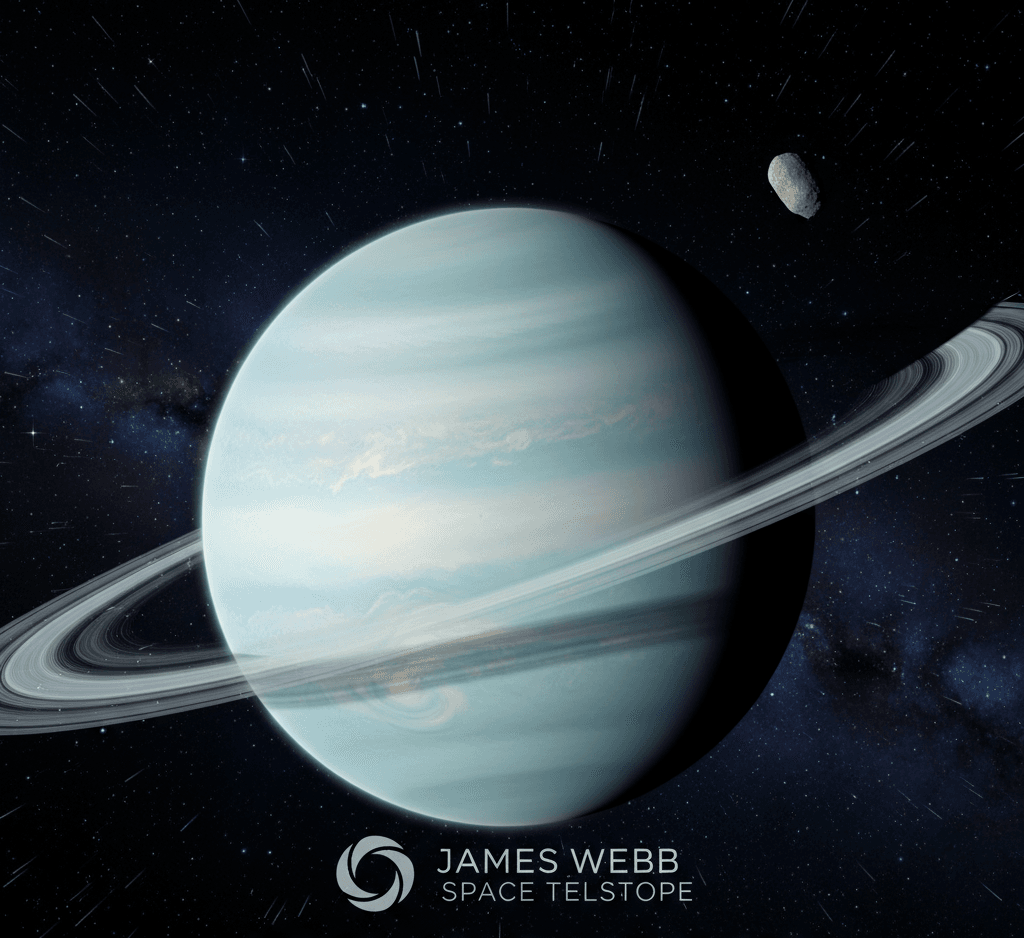
The James Webb Space Telescope (JWST), humanity’s most advanced eye in the cosmos, has discovered something extraordinary: a new moon orbiting Uranus, officially designated S/2025 U1.
At first glance, it might seem like just another small rock drifting through space. But in truth, this discovery opens a new chapter in our understanding of Uranus—and in humanity’s never-ending quest to uncover the universe’s hidden wonders.
The Legacy of James Webb: Humanity’s Eye in the Darkness
When the James Webb Space Telescope was launched in December 2021, it carried not just instruments and sensors but the hopes of an entire generation. Designed to look deeper into the cosmos than ever before, JWST was humanity’s attempt to see the invisible—to capture light that has traveled billions of years, to witness the birth of stars, and perhaps even the fingerprints of life.
Its golden mirrors, unfolding in the cold vacuum of space, became a symbol of precision and courage. Over the years, JWST has delivered astonishing images: newborn stars wrapped in nebulae, the faint glow of galaxies formed at the dawn of time, and the chemical fingerprints of distant exoplanets.
And now, it has turned its gaze closer to home—to the seventh planet of our solar system, Uranus—and made a discovery that reminds us that even in our own cosmic neighborhood, mysteries still wait in the shadows.
A Hidden Companion: How S/2025 U1 Was Found
The discovery began quietly, almost humbly. While analyzing infrared images of Uranus taken by the JWST during its 2025 observation cycle, a group of astronomers noticed a faint, moving speck of light near the planet’s rings.
At first, it was dismissed as a data artifact—a piece of cosmic dust or background noise. But over time, as multiple images were layered and analyzed, the speck moved in a predictable path.
It wasn’t random.
It was orbiting Uranus.
Further study confirmed it: this was a new moon, never before seen by telescopes on Earth or by the Voyager 2 spacecraft, which flew past Uranus in 1986.
The team named it provisionally S/2025 U1, following the standard astronomical convention (“Satellite / Year / Uranus / Discovery Number 1”).
Though tiny—just about 15 kilometers wide—its discovery is monumental. Finding such a small moon at a distance of nearly three billion kilometers from Earth showcases the staggering power and precision of the James Webb Telescope.
The Challenges of Seeing the Invisible
Detecting something as small as S/2025 U1 is like spotting a grain of sand from thousands of miles away. Uranus itself doesn’t make it easy—its faint rings and hazy atmosphere scatter light, and its tilt makes observing it from Earth particularly challenging.
Previous missions and ground-based observatories had mapped most of the planet’s larger moons—Titania, Oberon, Umbriel, Ariel, and Miranda—each named after characters from Shakespeare’s works. But smaller moons, orbiting close to or far beyond the planet’s main rings, often remain unseen, hidden by glare or lost in the background of deep space.
The Webb telescope, however, operates differently. Its infrared vision can pierce through dust and gas, detecting the faint warmth of even the coldest objects. While Uranus itself sits at a freezing –224°C, its moons, warmed slightly by reflected sunlight and internal energy, emit just enough infrared radiation for JWST to detect.
That’s how the faint, rhythmic pulse of S/2025 U1 was caught—a whisper in the darkness that became a story across the world.
Why This Discovery Matters
You might wonder: why is finding a tiny moon so important? After all, Uranus already has at least 27 known moons. What difference does one more make?
In science, the smallest clues can lead to the biggest answers. Each moon around a planet carries a piece of its history—a frozen record of collisions, gravitational battles, and cosmic migrations.
This new moon could help scientists:
- Understand Uranus’ ring system, which appears unusually young and dynamic.
- Reveal clues about the planet’s violent past, including the massive impact that likely tilted Uranus on its side billions of years ago.
- Improve models of moon formation, showing how small objects can coalesce from ring material or captured debris.
In short, S/2025 U1 is not just a moon—it’s a messenger from the past, carrying secrets from an age when the solar system was still forming.
The Mystery of Uranus: A Planet of Extremes
Uranus has always been a planet of contradictions. Its atmosphere, rich in methane, gives it that ghostly turquoise glow. But beneath its calm appearance lies chaos—hurricane-force winds, strange magnetic fields, and an axis tilted 98 degrees from vertical.
This tilt makes Uranus unique: it literally rolls around the Sun on its side, causing seasons that last over 20 years each. For decades, astronomers have struggled to explain why.
The leading theory suggests that Uranus suffered a colossal collision with an Earth-sized body billions of years ago—a blow so powerful it knocked the planet sideways. If true, then many of Uranus’ moons might be fragments of that ancient impact.
S/2025 U1 could be one of those fragments—a wandering survivor from that primordial chaos.
A Symphony of Moons
Uranus’ moons form a beautiful and complex family. Each one dances in its own orbit, some close to the planet’s shimmering rings, others far out in deep space.
- Titania, the largest moon, is scarred with canyons that stretch hundreds of miles.
- Miranda looks like a world that shattered and reassembled itself, with cliffs higher than Mount Everest.
- Ariel glows with icy ridges and frozen flows that may once have been liquid water.
Now, S/2025 U1 joins this cosmic symphony. Though tiny, it adds a new note to the music of Uranus’ system—a delicate rhythm only the Webb Telescope could hear.
The Role of the James Webb Telescope
This discovery also highlights the expanding versatility of the James Webb Space Telescope. While its main mission focuses on distant galaxies and the early universe, astronomers are increasingly using JWST for solar system research.
Webb’s ability to capture infrared data means it can observe cold worlds like Neptune, Uranus, and their moons in ways the Hubble or ground-based telescopes never could.
Already, JWST has revealed unprecedented detail in Jupiter’s auroras, Saturn’s rings, and the icy structures of distant Kuiper Belt objects. The Uranus moon discovery confirms what many suspected: Webb is not just a telescope for distant galaxies—it’s a window into our own cosmic backyard.
A Human Story Behind the Discovery
Behind every scientific milestone, there are people—dreamers, data analysts, astronomers, engineers, and programmers.
The discovery of S/2025 U1 began when Dr. Leah Romero, an astrophysicist at the University of Arizona, noticed a faint moving dot during a late-night data review session. As she later described in an interview:
“I almost deleted the frame. It was so faint I thought it was noise. But something about its motion felt too deliberate. I ran the model twice… and it lined up perfectly with Uranus’ gravity field. That’s when I knew.”
Her quiet excitement spread through the research team, followed by weeks of verification, simulation, and peer review. When NASA confirmed the data, there were cheers, tears, and a long moment of silence—the kind of silence that comes from realizing you’ve added a new chapter to human history.
How S/2025 U1 Might Have Formed
Scientists have several theories about how Uranus’ new moon came to be:
- Captured Object:
S/2025 U1 may have been a wandering rock—a leftover piece from the formation of the Solar System—captured by Uranus’ gravity millions of years ago. - Fragment of a Collision:
It could also be debris from a past collision between two moons or between a moon and a large asteroid. - Ring Material Coalescence:
Another theory suggests it formed gradually from Uranus’ faint outer rings—dust and ice slowly clumping together over time.
Whatever its origin, its existence helps refine our understanding of how planetary systems evolve and maintain stability over billions of years.
A Cosmic Reminder: We’re Still Discovering
There’s something deeply humbling about realizing that, in 2025, we’re still discovering new moons within our own solar system.
For all our technology and exploration, there remain corners of our cosmic neighborhood we’ve barely touched. The discovery of S/2025 U1 reminds us that the universe isn’t static—it’s alive, dynamic, and endlessly surprising.
As Dr. Romero said:
“It’s comforting to know there are still things out there waiting to be found. Even close to home, the universe keeps secrets—and it’s up to us to listen.”
Looking Ahead: The Future of Uranus Exploration
This discovery comes at a perfect time. NASA and the European Space Agency (ESA) are currently planning a flagship Uranus Orbiter and Probe mission, set to launch in the early 2030s.
That mission will study Uranus’ atmosphere, rings, and moons up close—possibly providing a direct look at S/2025 U1 for the first time.
With JWST guiding the way, humanity now knows exactly where to look. When the Uranus probe arrives, we might finally learn what this tiny moon is made of—rock, ice, or something entirely unexpected.
It’s an exciting reminder that each discovery is a stepping stone to the next.
The Emotional Side of Science
Science isn’t just about data or equations. It’s about wonder.
Think about it: somewhere, billions of miles away, a small moon has been circling Uranus for eons—unseen, unnamed, and unacknowledged. And then, one day, a few pixels of infrared light reveal its existence.
That’s the beauty of discovery. It transforms the invisible into something real, something human.
For every child looking up at the night sky, wondering what’s out there, this story is a quiet message: there’s always more to find.
A Universe of Stories Yet Untold
The James Webb Telescope’s discovery of S/2025 U1 is more than a technical achievement; it’s a symbol of human curiosity and perseverance. It shows that our desire to explore never fades—it only evolves.
We began with telescopes made of glass and brass. Now, we use mirrors coated with gold, floating a million miles from Earth. And yet, the feeling is the same: that spark of awe, that whisper of possibility.
Maybe that’s what makes discoveries like this so powerful. They remind us that the universe is not just a place—it’s a story we’re still writing.
Final Thoughts: The Quiet Moon Beyond the Blue
As of now, S/2025 U1 remains a faint dot in a distant orbit—no spacecraft has yet seen it up close. But in time, we will learn its shape, its texture, and its dance around Uranus.
And when we do, we’ll remember the night the James Webb Space Telescope—a marvel of human ingenuity—looked into the darkness and found something new.
It’s not just about finding another moon. It’s about proving, once again, that the universe is alive with mysteries, waiting for curious minds to uncover them.
Perhaps the most poetic truth of all is this:
While the universe is infinite, so too is our capacity to wonder.
References
- NASA Official Press Release – James Webb Space Telescope
🔗 https://www.nasa.gov/webb - NASA Solar System Exploration – Uranus Overview
🔗 https://solarsystem.nasa.gov/planets/uranus/overview - European Space Agency (ESA) – JWST Mission Page
🔗 https://www.esa.int/Science_Exploration/Space_Science/Webb - Space.com – James Webb Discovers New Moon Around Uranus
🔗 https://www.space.com/james-webb-new-moon-uranus - Scientific American – The Mysterious Moons of Uranus
🔗 https://www.scientificamerican.com/article/uranus-moons-mystery - The Planetary Society – Uranus Exploration and Future Missions
🔗 https://www.planetary.org/space-missions/uranus-orbiter - Live Science – Webb Telescope Captures Stunning Images of Uranus
🔗 https://www.livescience.com/webb-telescope-uranus-images - BBC Science Focus – New Discoveries from the James Webb Telescope
🔗 https://www.sciencefocus.com/space/james-webb-discoveries - National Geographic – Hidden Wonders of the Outer Planets
🔗 https://www.nationalgeographic.com/science/article/uranus-moons - Space Telescope Science Institute (STScI) – Webb Observations of Uranus
🔗 https://webbtelescope.org/contents/news-releases/2025/uranus-new-moon