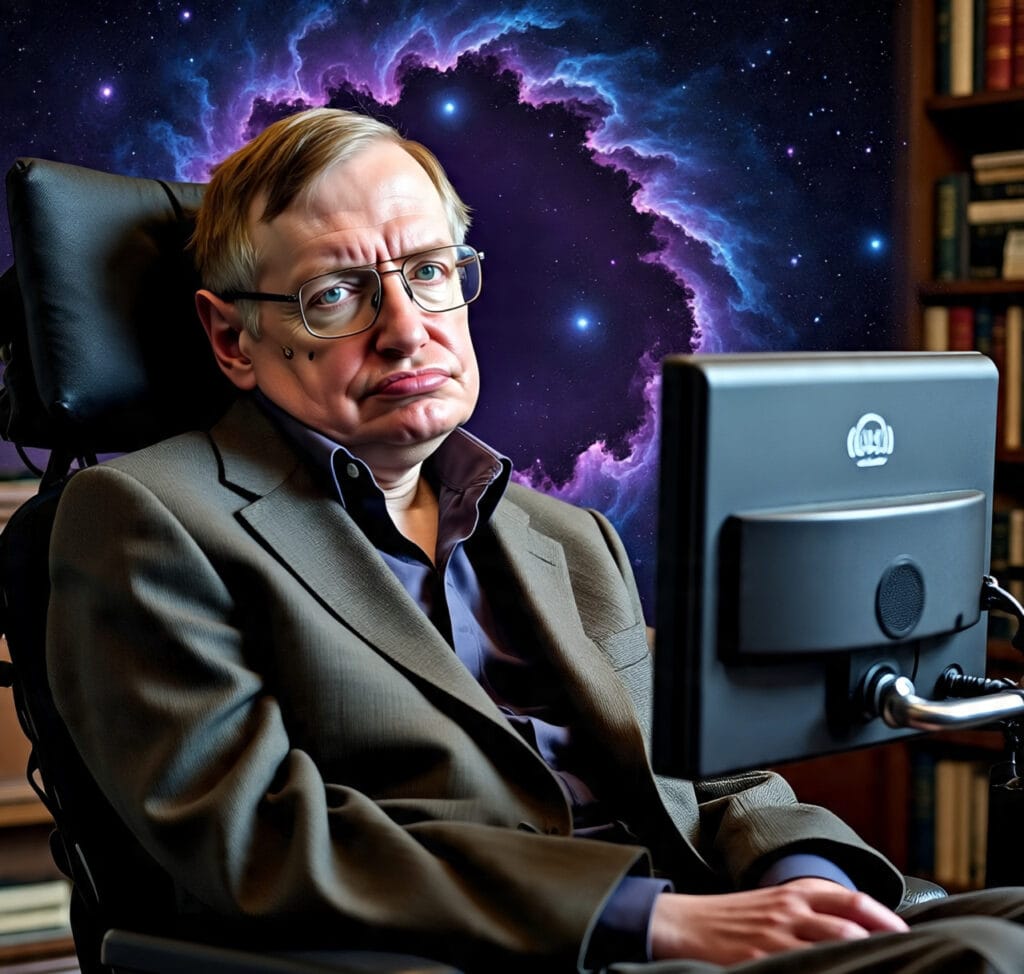
Stephen Hawking
Stephen Hawking is remembered as one of the greatest scientific minds of all time. His inspiring journey from an ordinary student to a world-famous physicist is a story of determination, courage, and genius. Despite living with a serious illness that paralyzed his body, Hawking continued to explore the universe with his brilliant mind. His groundbreaking theories about black holes, time, and the origin of the cosmos have influenced generations of scientists and thinkers around the world.
Early Life of Stephen Hawking
Stephen William Hawking was born on 8 January 1942 in Oxford, England, exactly 300 years after the death of the legendary astronomer Galileo Galilei.
- His father, Frank Hawking, was a medical researcher.
- His mother, Isobel Hawking, was one of the first women to study at Oxford.
- Stephen grew up in St. Albans, where he showed a natural curiosity about how things worked.
Although he was not considered an exceptional student during his childhood, his imagination and passion for science were extraordinary. He loved building model airplanes, making fireworks, and creating makeshift computers with his friends.
Education and Early Academic Journey
At the age of 17, Stephen Hawking entered University College, Oxford, to study physics. Initially, he found the academic environment too easy and admitted that he barely studied for his exams. Yet, his sharp mind helped him graduate with honors.
Later, he went to Cambridge University to pursue a PhD in cosmology under the guidance of Dennis Sciama, one of the leading scientists of that time. This was the place where his ideas about the universe began to take shape.
The Diagnosis: Battling ALS
When Hawking was just 21 years old, he was diagnosed with Amyotrophic Lateral Sclerosis (ALS), also known as Lou Gehrig’s disease. Doctors told him that he had only a few years to live.
This news was devastating, but instead of giving up, Hawking decided to focus on his research and make every moment count. Over the years, the disease gradually paralyzed him, leaving him unable to walk, talk, or move most of his body.
Yet, with the help of a speech-generating device, he continued to lecture, write books, and share his knowledge with the world. His resilience turned him into a global symbol of strength and determination.
Major Scientific Contributions
Black Holes and Hawking Radiation
One of Hawking’s most famous discoveries was that black holes are not completely black. Instead, they emit a form of radiation, now known as Hawking radiation. This revolutionary idea changed the way scientists understand black holes and quantum physics.
The Nature of the Universe
Hawking studied the Big Bang Theory and the origin of time. He argued that the universe has no boundaries, meaning that space and time are finite but have no edge. This concept opened new doors in cosmology and theoretical physics.
Unified Theory of Physics
He also worked on the possibility of creating a “Theory of Everything,” a single framework that could explain the laws of nature—bringing together general relativity and quantum mechanics.
Books by Stephen Hawking
Hawking was not just a scientist; he was also a brilliant communicator. He wrote several best-selling books that made complex science understandable to the general public.
- A Brief History of Time (1988): Sold over 25 million copies worldwide.
- The Universe in a Nutshell (2001): Explained advanced theories with illustrations.
- The Grand Design (2010): Co-authored with Leonard Mlodinow, exploring the laws of physics.
- Black Holes and Baby Universes (1993): A collection of essays and lectures.
His books continue to inspire young scientists and curious minds across the globe.
Awards and Recognition
Stephen Hawking received countless awards and honors for his contributions:
- Albert Einstein Medal (1979)
- Wolf Prize in Physics (1988)
- Presidential Medal of Freedom (2009), the highest civilian award in the United States
- Fellow of the Royal Society
Although he never won a Nobel Prize, his ideas had a lasting impact on modern physics.
Personal Life and Challenges
In 1965, Hawking married Jane Wilde, a student he had met before his diagnosis. Together they had three children: Robert, Lucy, and Timothy. Despite his health challenges, he tried to live as normal a family life as possible.
Later, Hawking and Jane divorced, and he married his nurse, Elaine Mason, though the marriage ended after some years.
His personal life had ups and downs, but his dedication to science never wavered.
Inspiring Quotes by Stephen Hawking
Stephen Hawking left behind words of wisdom that continue to motivate millions. Some of his most inspiring quotes include:
- “However difficult life may seem, there is always something you can do and succeed at.”
- “Intelligence is the ability to adapt to change.”
- “Remember to look up at the stars and not down at your feet.”
Legacy of Stephen Hawking
Stephen Hawking passed away on 14 March 2018, on the anniversary of Albert Einstein’s birth. The coincidence highlighted the symbolic connection between two of the greatest minds in history.
His legacy lives on through his research, books, and the inspiration he gave to millions of people worldwide. He proved that the power of the human mind can overcome even the greatest physical challenges.
Conclusion
The life of Stephen Hawking is more than just a story of science—it is a story of hope, courage, and the limitless possibilities of the human spirit. He showed the world that disability does not define a person’s abilities. His discoveries transformed physics, and his perseverance inspired generations to dream bigger.
Stephen Hawking’s biography is not only about achievements and discoveries but also about the strength to rise above challenges. His journey continues to remind us that with determination, even the impossible becomes possible.