
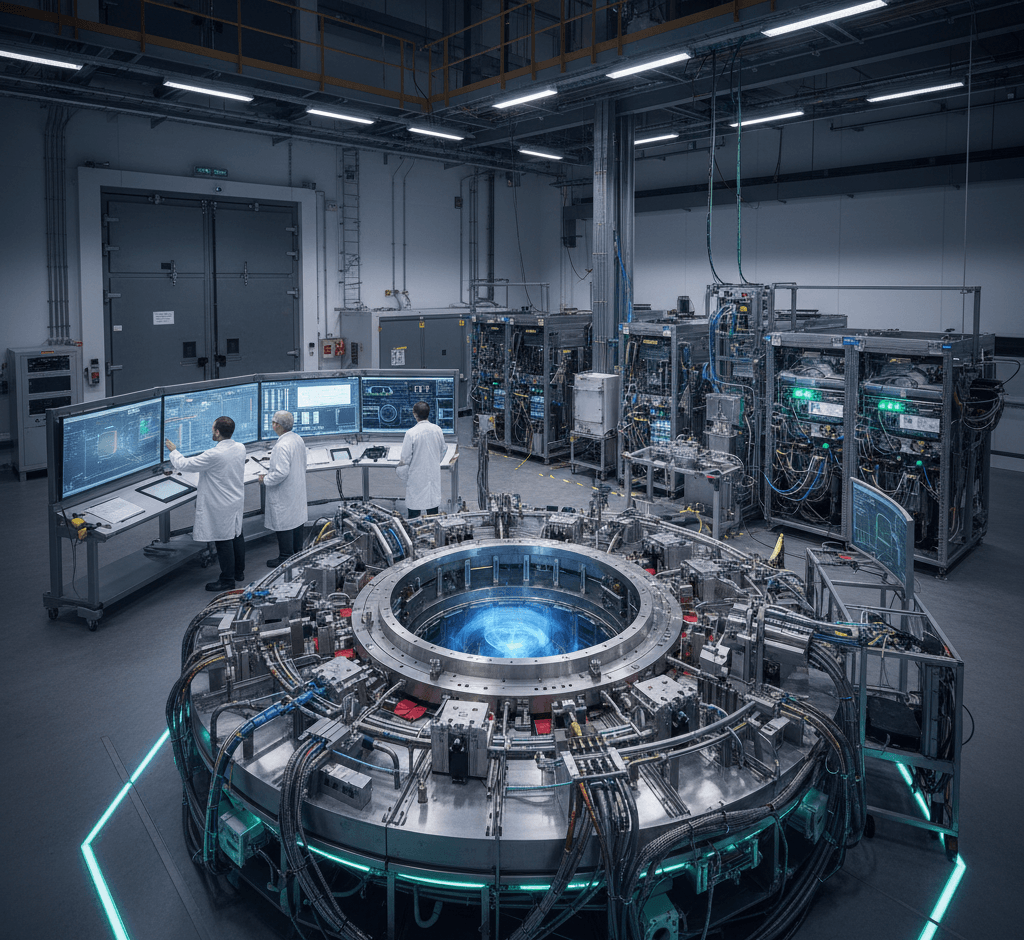
CERN Experiments with Antimatter
“We know more about the laws that govern the stars than we do about antimatter right here on Earth”—this is the feeling many physicists share. Antimatter remains one of the greatest mysteries in physics: why does it seem almost absent in the universe, despite theory predicting it should have been created in equal amounts to matter? CERN, the European Organization for Nuclear Research, is pushing the boundaries to answer this question. In this article, we’ll dive deep into what CERN scientists are doing with antimatter—recent breakthroughs, experiments, challenges, and what they might reveal about the universe.
Table of Contents
- What is Antimatter & Why CERN Studies It
- Key CERN Facilities & Experiments
- Recent Breakthroughs & Research Updates
- Rapid Cooling of Antiprotons (BASE)
- Laser Cooling & Positronium in AEgIS
- Measuring Gravity’s Effect on Antimatter (ALPHA-g)
- Progress Towards Antihydrogen Beams (ASACUSA)
- Exotic Antimatter Nuclei: Antihyperhelium-4 (ALICE)
- Antimatter Qubits & Precision Measurements (BASE)
- Why These Experiments Matter (Physics & Beyond)
- Challenges & Technical Hurdles
- What’s Coming Next: Future Plans
- Conclusion
1. What is Antimatter & Why CERN Studies It
Antimatter is like the mirror twin of ordinary matter. For every fundamental particle (proton, electron, etc.), there is an antimatter counterpart (antiproton, positron, etc.) that has the same mass but opposite charge and other quantum numbers. When matter meets antimatter, they annihilate, converting mass into energy, typically gamma rays, according to Einstein’s famous E=mc2E=mc^2E=mc2.
Physics theories, especially those describing the Big Bang, suggest that matter and antimatter were created in almost equal amounts in the early universe. So why is our visible universe dominated by matter? Why didn’t matter get annihilated by antimatter soon after creation?
That question—often called the matter-antimatter asymmetry—is one of the deepest in modern physics. CERN’s antimatter program tries to probe this by comparing the properties of matter vs antimatter with extremely high precision, testing fundamental symmetries (like CPT symmetry: Charge, Parity, Time reversal), gravity’s effect on antimatter, and more.
2. Key CERN Facilities & Experiments
To understand recent updates, you need to know what equipment and experiments are active:
- Antiproton Decelerator (AD): This decelerates antiprotons so they are slow (low energy), making them easier to trap and manipulate.
- ELENA (Extra Low Energy Antiproton ring): Makes AD’s antiprotons even slower and cooler, increasing precision.
Major experiments using AD/ELENA:
- ALPHA (Antihydrogen Laser Physics Apparatus) – traps antihydrogen atoms and studies their properties.
- AEgIS (Antimatter Experiment: Gravity, Interferometry, Spectroscopy)—focuses on measuring how antimatter responds to gravity, among other things.
- ASACUSA (Atomic Spectroscopy And Collisions Using Slow Antiprotons)—works on antihydrogen beams and hyperfine spectroscopy.
- BASE (Baryon Antibaryon Symmetry Experiment)—precision measurement of fundamental properties of antiprotons (e.g., magnetic moment) and comparing them to protons.
- ALICE—while not exclusively antimatter-focused, with its heavy-ion collisions, it also studies antimatter nuclei (like antinuclei and antihypernuclei).
3. Recent Breakthroughs & Research Updates
Here are some of the most exciting recent advances from CERN’s antimatter research.
Rapid Cooling of Antiprotons (BASE)
- In August 2024, the BASE experiment published a breakthrough: a new device that drastically reduced the time needed to cool antiprotons from roughly 15 hours to just about 8 minutes. CERN
- They also reduced how long antiprotons sit in the cooling trap per cycle (from ~10 minutes to ~5 seconds) and improved measurement traps to reduce measurement time by fourfold. CERN
- Why it matters: Cooling antiprotons very close to absolute zero drastically lowers noise and allows much more precise measurements of their fundamental properties (magnetic moment, charge-to-mass ratio) compared to protons. Detecting extremely tiny differences could help explain why matter dominates antimatter. BASE aims to measure the magnetic moment of antiprotons vs protons to a precision of a tenth or even a hundredth of a billionth (i.e., parts per 101010^{10}1010–101110^{11}1011). CERN
Laser Cooling & Positronium in AEgIS
- The AEgIS experiment reported success in laser cooling of positronium (a short-lived “atom” made of an electron and a positron) in March 2024. ep-news.web.cern.ch
- Positronium is harder than typical atoms because it’s neutral and decays quickly. Cooling means slowing down its motion so experiments can observe it more cleanly. This opens up precision tests of antimatter under gravity, spectroscopy, and possibly tests of fundamental symmetries. ep-news.web.cern.ch
Measuring Gravity’s Effect on Antimatter (ALPHA-g)
- A big question: Does antimatter “fall down” the same way matter does under gravity? CERN’s ALPHA experiment has been working on devices like ALPHA-g to test this. ep-news.web.cern.ch+1
- In a recent press release, ALPHA reported that antihydrogen atoms, when released from traps, showed behavior consistent with gravitational attraction (i.e., “dropping” downward) within the experimental error (around 20% of ggg, where ggg is Earth’s gravitational acceleration). CERN
- The experiment involves holding neutral antihydrogen (so electromagnetic forces don’t dominate), letting them go, and measuring where they annihilate (top vs bottom of trap) when they fall. That gives data on the gravitational acceleration of antimatter. ep-news.web.cern.ch+1
Progress Towards Antihydrogen Beams (ASACUSA)
- One challenge is not just trapping antihydrogen, but making a beam of it so you can do measurements in flight. ASACUSA is pushing toward that. CERN
- Their method involves using a CUSP trap, where antiprotons and positrons are combined, forming antihydrogen, which is then guided along a vacuum pipe to be studied. So far, only small numbers of antiatoms have been made in beam form, but this technique is being refined. CERN
Exotic Antimatter Nuclei: Antihyperhelium-4 (ALICE)
- In April 2025, the ALICE Collaboration (one of CERN’s detectors at the LHC) reported seeing the antihyperhelium-4 nucleus. alice-collaboration.web.cern.ch
- This is the heaviest antimatter nucleus observed so far and contains antiprotons, antineutrons, and a hyperon (a strange quark particle). It’s created in the hot, dense conditions of heavy-ion collisions. alice-collaboration.web.cern.ch
- Why important: such observations allow tests of nuclear physics models under extreme conditions (similar to the early universe), constraints on how antimatter nuclei form, and maybe clues about strange quark contributions in cosmic rays or astrophysics.
Antimatter Qubits & Precision Measurements (BASE)
- In July 2025, BASE made another leap: they demonstrated an antimatter quantum bit (qubit). They held an antiproton oscillating between two spin states for almost one minute while trapped. This was reported in Nature. CERN
- This matters because qubit techniques allow exceptionally sensitive tests of whether properties of antiprotons (spin transitions, magnetic moments) match those of protons to very high precision. Any tiny discrepancy could be a window into new physics beyond the Standard Model.
4. Why These Experiments Matter (Physics & Beyond)
Understanding what CERN’s doing with antimatter isn’t just “cool physics”—it has deep implications:
- Testing fundamental symmetries: CPT symmetry, for example, predicts that properties of antimatter mirror those of matter. If that’s violated, our understanding of quantum field theory and the Standard Model would need revision.
- Origin of matter-antimatter asymmetry: Why is there almost no antimatter in the observable universe? These precise measurements (properties, gravitational behavior, etc.) could hint at why more matter survived.
- Gravity & quantum mechanics overlap: Antimatter tests how gravity behaves in the quantum regime, a field where current theory is weak. Results could feed into ideas of quantum gravity or propose new forces.
- Astrophysics & cosmology: Observations of antimatter nuclei (like antihyperhelium) contribute to understanding cosmic rays, antimatter in space, and conditions just after the Big Bang.
- Technological spin-offs: The techniques for trap cooling, laser cooling, precision measurements, qubit control, magnetic field design, etc. often lead to innovations in sensors, cryogenics, quantum computing, etc.
5. Challenges & Technical Hurdles
Though progress is impressive, the work is extremely difficult. Here are some of the biggest obstacles:
- Cooling and trapping antimatter: Antimatter annihilates upon contact with ordinary matter. To study it, you must trap it—often with magnetic or electromagnetic traps—in ultra-high vacuum, at extremely low temperatures. Even then, it decays or escapes.
- Producing enough antimatter: Generating enough antiprotons and positrons and then combining them into antihydrogen in sufficient numbers is nontrivial. Beam intensity (number of antiatoms in a beam) is still low in many experiments.
- Measuring gravity on neutral antimatter: Gravity is a weak force compared to electromagnetic forces. To observe gravitational free fall of antihydrogen, the atom must be neutral and isolated from electromagnetic influences, which is technically challenging. Precision is still low (so far ~20% uncertainty in measurement of gravity acceleration on antimatter) in ALPHA-g, CERN.
- Spectroscopic precision: For example, hyperfine transitions and energy level differences are very small. External magnetic fields, trapped imperfections, motional effects, etc., all introduce noise and distortions.
- Lifetime limitations: Even once antihydrogen atoms are trapped, their lifetimes in traps are limited; they eventually annihilate due to collisions with residual gas or because of trap instabilities. Longer confinement times help, but achieving extremely long times without perturbation is hard.
- Data quality & statistics: Many measurements depend on having enough events (enough antiatoms, enough annihilations, enough beams). Low statistics make error bars large; pushing down uncertainties requires more data, better detection, and refinement of apparatus.
6. What’s Coming Next: Future Plans
CERN’s program isn’t slowing down. Here are what they aim to do and likely future developments:
- Improving precision: BASE aims to push the precision of antiproton property measurements to parts per 101010^{10}1010 or 101110^{11}1011. Any tiny difference found between protons and antiprotons could be revolutionary. CERN+1
- Better gravity experiments: More refined experiments to see how antihydrogen falls (free-fall), with lower uncertainties. The ALPHA-g apparatus will be refined with more trials, better control of magnetic bias fields, etc. ep-news.web.cern.ch+1
- Larger beams of antihydrogen: ASACUSA and others are working to produce stronger, more stable beams so that experimenters can measure properties in flight rather than in traps. Beamline stability, detection, shielding, etc., will be improved. CERN
- Further cooling & manipulation: AEgIS’s advances with laser cooling of positronium will lead to cooler, more controlled antimatter atoms. Also, methods to get antihydrogen into ground states more efficiently (stimulated deexcitation, etc.) are under study. arXiv+1
- Transportable antimatter traps & expanded infrastructure: To reduce background noise (e.g., from magnetic fields or vibrations), experiments may use mobile setups or more isolated labs. There are discussions about better facilities and upgraded detection methods. arXiv
- Exotic antimatter and nuclei studies: ALICE’s antihyperhelium-4 is just a start. More such antimatter hypernuclei might be found, and studying them could inform astrophysics and perhaps shed light on cosmic ray composition or antimatter abundances in space. alice-collaboration.web.cern.ch
7. Conclusion
CERN’s antimatter research is a beautiful blend of high-precision engineering, fundamental science, and philosophical questions. Every tiny advancement—cooling antiprotons faster, trapping antihydrogen longer, measuring how it falls, or producing heavier antimatter nuclei—adds a piece to the puzzle: Why does our universe have mostly matter?
Though no result so far has shown a major violation of expected behavior (i.e., matter and antimatter still appear to behave symmetrically in many respects), CERN’s latest work is closing in on the precision needed to possibly reveal something new.
For someone fascinated by the cosmos, these experiments are more than academic—they are steps toward understanding our existence.
References
- CERN – Breakthrough in Rapid Cooling for BASE Antiprotons
https://www.home.cern/news/news/experiments/breakthrough-rapid-cooling-base-antiprotons - CERN – ALPHA Experiment Observes Influence of Gravity on Antimatter
https://home.cern/news/press-release/physics/alpha-experiment-cern-observes-influence-gravity-antimatter - CERN – AEgIS Experiment Breakthrough: Laser Cooling of Positronium
https://ep-news.web.cern.ch/content/aegis-experiment-breakthrough-laser-cooling-opens-door-new-antimatter-studies - ALICE Collaboration – Discovery of Antihyperhelium-4 Nucleus
https://alice-collaboration.web.cern.ch/2025-anti-hypernuclei-PRL