Amazing NASA Discovery: Proof of Life Found on Mars
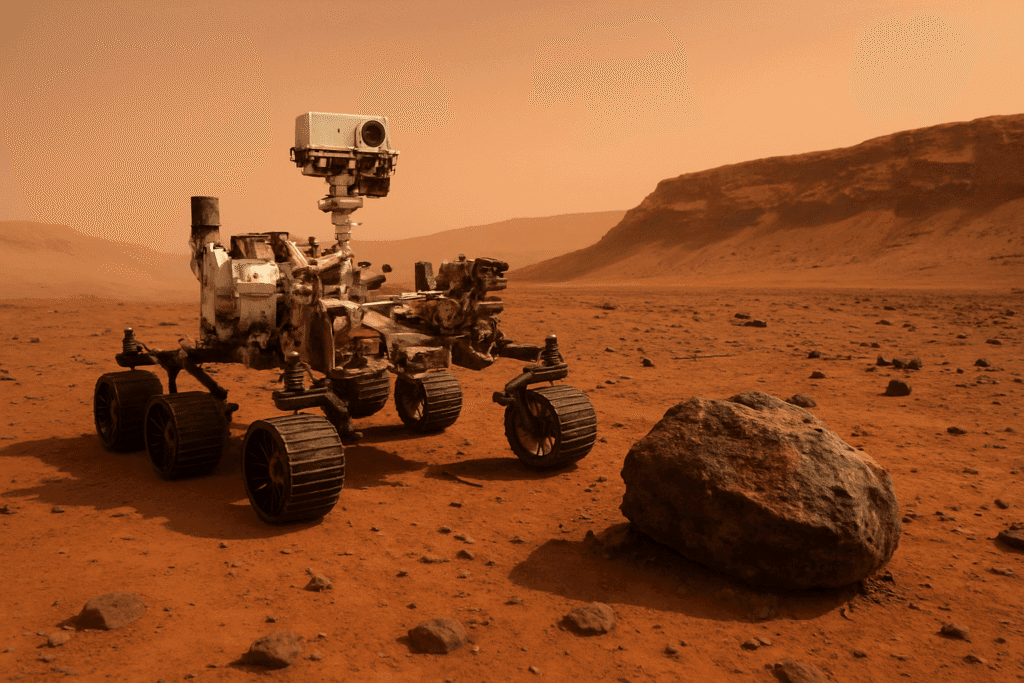
In a groundbreaking announcement in September 2025, NASA revealed that the Perseverance rover has found what could be the strongest evidence yet that life may once have existed on Mars. While scientists emphasize that this is not definitive proof, the latest findings open up exciting possibilities—and also highlight the need for further study.
What Was Found
The sample, nicknamed “Sapphire Canyon,“ was collected in July 2024 from a Martian rock known as “Cheyava Falls,” situated within the Bright Angel formation in the ancient river valley Neretva Vallis, which feeds into Jezero Crater. AP News +3Reuters+3NASA+3
This rock is a clay-rich mudstone, estimated to be approximately 3.2 to 3.8 billion years old, from a time when scientists believe Mars had liquid water on its surface. Reuters+2NASA+2
Clues Pointing Toward Ancient Microbial Life
Textures and Features
Perseverance’s instruments identified unusual textures on the surface of Cheyava Falls. These include dark spots and rings, described colloquially as “leopard spots” and “poppy seeds.” Such patterns are noteworthy because on Earth, similar formations are often the results of microbial activity. Reuters+2Sky at Night Magazine+2
Mineral Chemistry and Organics
The rock contains several chemical and mineral signatures that suggest conditions favorable for former life:
- Organic carbon, which is a basic building block of life. NASA+2AP News+2
- Minerals such as vivianite (an iron-phosphate) and greigite (an iron-sulfide). On Earth, these minerals are often formed in environments where microbes metabolize iron and sulfur compounds. Reuters + 2The Guardian + 2
- Oxidized iron and phosphorus, plus sulfur-bearing compounds, all of which could support microbial metabolism. NASA+1
Environmental Conditions
The region where Cheyava Falls was found shows evidence of ancient lake beds and river channels, making it more likely that this area once had water, more temperate conditions, and potentially habitable environments. Reuters+2NASA+2
Also, the rock shows no strong evidence of having been subjected to high heat or severe acidic conditions, which could destroy fragile organic signatures, making the possibility of preserved biosignatures more credible. Reuters + 2Planetary Society + 2
Why It’s Not Proof—Yet
While the data are compelling, scientists are clear: these findings are potential biosignatures, not confirmed life. Several alternate explanations must be ruled out first.
- Similar mineral structures can form through non-biological (abiotic) processes involving chemistry, geology, or environmental shifts. Reuters+2Sky at Night Magazine+2
- Organic compounds may survive over geologic timescales without being part of living organisms. Distinguishing those from true microbial signatures is very challenging. Planetary Society +1
- The instruments aboard Perseverance have limits—they cannot replicate all analyses that Earth labs can perform. For example, isotopic ratios, microfossil structures, or detailed molecular analyses may give more definitive answers but require sample return. Planetary Society +1
The Importance of Sample Return
To move from “potential” to “definitive,” scientists need to study these samples in detail on Earth. The Mars Sample Return mission, a partnership of NASA and ESA, aims to collect and bring back multiple rock and soil samples from Mars. AP News +2Planetary Society + 2
However, this mission is costly and complex. Factors like funding, technical challenges, and time delays pose serious risks. The recent discovery only underscores how valuable that mission is—but also how fragile the future of such projects may be in the face of budget cuts and logistical constraints. The Verge + 1
What It Means If True
If these findings are indeed evidence of ancient life on Mars, the implications are enormous:
- Science: It would confirm that life did not arise uniquely on Earth; that under favorable conditions, life can emerge elsewhere. Our models of planetary habitability would shift dramatically.
- Philosophy & Human Understanding: Questions about our place in the universe would take on new weight. The knowledge that life once existed on another planet changes how we see ourselves, our history, and our destiny.
- Future Exploration: Missions may focus more on astrobiology, searching for life-forms or fossils, rather than just geology. There may be renewed pushes for human missions, more advanced rovers, and stronger international cooperation.
- Technology & Innovation: New tools and methods will be required to analyze biosignatures, preserve fragile samples, and avoid contamination.
What’s Next?
- Scientists will continue to analyze data from Perseverance’s instruments, looking for more clues and trying to eliminate non-biological explanations.
- Laboratory simulations on Earth will help test whether the features seen on Mars could form without life.
- The Mars Sample Return mission, if it proceeds successfully, will allow detailed analyses of Cheyava Falls / Sapphire Canyon and other samples in Earth labs.
- Researchers will likely revise models of early Mars climate, water activity, and habitability, using this discovery to inform new rover landing sites and mission design.
Challenges & Criticisms
- Funding Threats: Recent proposals for budget cuts at NASA could jeopardize follow-up missions, sample return efforts, and all the supporting infrastructure needed to confirm these findings. The Verge
- Scientific Caution: The scientific community remains alert to over-interpretation. False positives have happened before (e.g., meteorite ALH84001), where initial excitement was followed by more conservative interpretations. Planetary Society
- Public Expectation: The media and public may want definitive answers fast, but science takes time. Misleading headlines could lead to disappointment or distrust if clarity is not maintained.
Conclusion
The discovery of potential biosignatures in the Cheyava Falls/Sapphire Canyon sample marks perhaps the most promising step yet toward answering one of the greatest questions: has there ever been life beyond Earth?
While we are not yet at proof, the textures, minerals, and organic elements found in an ancient lake bed mudstone on Mars bring us much closer than ever before. The path forward will require patience, rigorous testing, and the successful return of samples to Earth. Still, for now, we stand on the threshold of potentially rewriting our understanding of life in the universe.