
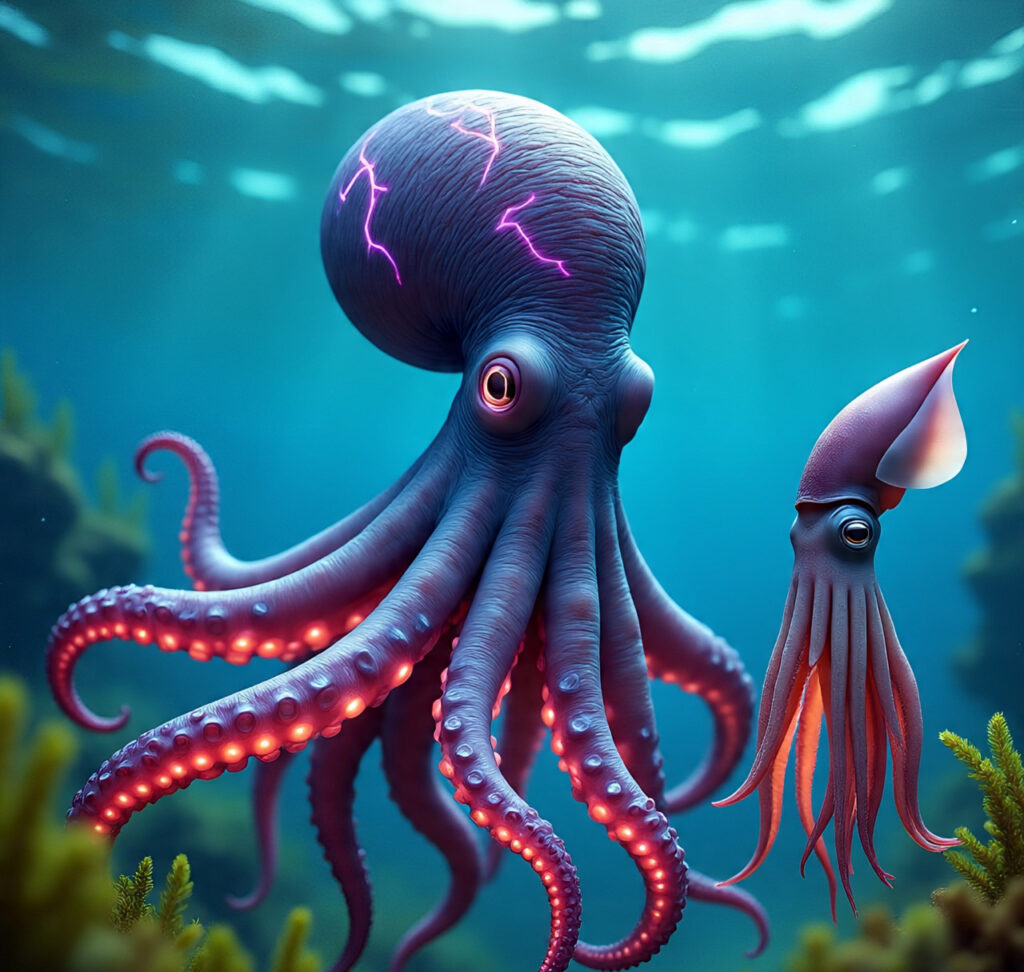
A Genetic Anomaly: How a Rare RNA Twist Makes Octopuses and Squids Smart
For decades, the astonishing intelligence of octopuses, squids, and cuttlefish—collectively known as cephalopods—has puzzled scientists. These invertebrates, with their unique nervous systems and lack of a protective skeleton, exhibit a level of cunning and problem-solving that rivals some of the most intelligent vertebrates. While their large brains and distributed nervous systems are part of the story, recent scientific discoveries point to a much more fundamental, and bizarre, genetic secret: a rare and extensive ability to edit their own RNA.
Beyond the Brain: A Distributed Network of Intelligence
To truly appreciate their intelligence, one must first understand their unique neurobiology. An octopus’s brain-to-body mass ratio is the largest of any invertebrate and on par with many vertebrates. However, a remarkable two-thirds of an octopus’s 500 million neurons are located in its eight arms, not in the central brain. Each arm can function semi-autonomously, with its own “mini-brain,” allowing it to taste, touch, and react independently.
This distributed nervous system enables a stunning array of behaviors:
- Tool Use: The veined octopus, for example, has been observed collecting and carrying coconut shells to use as a mobile shelter.
- Camouflage Mastery: Cephalopods can instantly change their skin color, pattern, and even texture to blend into their surroundings, a feat of both physical and mental dexterity.
- Problem-Solving: Octopuses have famously demonstrated their ability to escape from sealed jars and solve mazes, showing a remarkable capacity for learning and memory.
While these behaviors are impressive, they only scratch the surface of the underlying biological mechanism that makes this intelligence possible.
The Genetic Twist: RNA Editing on a Massive Scale
In most animals, including humans, DNA acts as a fixed blueprint. The instructions encoded in DNA are transcribed into a messenger molecule called RNA, which is then translated into proteins. This process is highly regulated and rigid. While a small number of “edits” can occur to the RNA in humans, they are rare and typically don’t change the final protein.
Cephalopods, however, have evolved a radically different approach. They possess an extraordinary ability to extensively edit their RNA molecules, particularly those involved in neural function.
- Fact 1: A Unique Genetic Strategy: Instead of relying on slow, long-term DNA mutations to adapt and evolve, octopuses, squids, and cuttlefish use RNA editing as a form of rapid-response genetic tinkering. This process is mediated by an enzyme that can change the molecular code of RNA, effectively altering the “instructions” for building proteins without changing the underlying DNA blueprint.
- Fact 2: A Massive Scale: In humans, only about 40 RNA sites are edited in protein-coding regions. In cephalopods, scientists have found hundreds of thousands of such sites. In fact, a staggering 60% of an octopus’s protein-coding RNA is edited, a phenomenon unmatched in the animal kingdom.
- Fact 3: Dynamic Adaptation: This unique ability allows cephalopods to “fine-tune” their physiology in real-time in response to environmental changes. For example, when an octopus is exposed to cold water, its neurons can edit their RNA to produce slightly different versions of key proteins. These new protein variants function better in the colder temperatures, allowing the octopus to adapt on a physiological level without waiting for generations of evolutionary changes.
The Evolutionary Trade-Off
This incredible genetic flexibility comes with a trade-off. To maintain their vast capacity for RNA editing, cephalopods have had to give up some of the evolutionary dynamism seen in other species. Their DNA has remained relatively stable over millions of years, which is highly unusual for a complex, fast-evolving animal. The regions of their DNA that allow for RNA editing are so critical that they are rigidly conserved, limiting the potential for new DNA-based adaptations.
In essence, these creatures have swapped the long-term, irreversible changes of DNA-level evolution for the short-term, reversible adaptability of RNA editing. This trade-off has enabled them to achieve a level of intelligence and adaptability that would be impossible with a more conventional genetic strategy.
The study of cephalopod intelligence reveals a parallel path for the evolution of complex brains. By understanding their unique genetic and neurological makeup, we gain a new perspective on what intelligence is and how it can emerge through completely different evolutionary mechanisms.