Solar Eclipse Today 2025
The heavens are aligning, and on September 21–22, 2025, Earth witnesses a partial solar eclipse—one of the final celestial shows of the year. While this eclipse will not be a total eclipse in most places, its visibility, stages, safety guidelines, and cultural significance make it a must-follow event. Read on to get all the details: exactly when it happens globally, where you can see it, how to observe it safely, and why it matters.
What Is a Partial Solar Eclipse?
A solar eclipse occurs when the Moon moves between the Earth and the Sun, blocking some or all of the Sun’s light. In a partial solar eclipse, only part of the Sun is obscured by the Moon. The Sun appears as if a “bite” has been taken out of it. There is no period of total darkness like in a total solar eclipse. Even at maximum coverage, part of the Sun remains visible. Wikipedia+2EarthSky+2
Key Facts at a Glance
ParameterDetailDate September 21–22, 2025 EarthSky+2 Time and Date + 2 Type Partial solar eclipse EarthSky + 2 Wikipedia + 2Maximum obscuration (magnitude): about 0.855 (approx. 85% of the sun covered at peak) Wikipedia+1 Global times (UTC) The eclipse begins at ~ 17:29 UTC, reaches maximum at ~ 19:41 UTC, and ends at ~ 21:54 UTC. Time and Date + 2EarthSky+2
Time and Stages: When It Happens
The eclipse unfolds in distinct stages:
- Start (First Partial Contact)
At 17:29 UTC (5:29 pm UTC), the Moon’s penumbra begins to touch the Sun. From this point, part of the Sun is slowly obscured. EarthSky+2Time and Date+2 - Maximum Eclipse
Around 19:41–19:43 UTC, the eclipse reaches its peak. This is when the greatest portion of the Sun is covered by the Moon. Depending on your location, this might be experienced during sunrise or midmorning. EarthSky + 2 Wikipedia + 2 - End (Last Partial Contact)
By approximately 21:54–21:55 UTC, the penumbra leaves the Sun, and the eclipse ends. After this, the Sun returns to full brightness (weather permitting). Time and Date +2EarthSky+2
Where It Will Be Visible
Not everyone on Earth will see this eclipse. Its visibility is limited to certain regions—mostly in the Southern Hemisphere and over the South Pacific, New Zealand, parts of Antarctica, and a small portion of eastern Australia. Wikipedia+3EarthSky+3 Sky at Night Magazine + 3
More precisely:
- New Zealand (especially the southern parts like Dunedin, Stewart Island, and southern coastlines) will see a very good view of the eclipse at sunrise or just after. Sky at Night Magazine + 2 EarthSky + 2
- Australia (southeast/east tip) will see limited visibility—only a sliver of the Sun obscured, and mostly as the Sun is rising. Sky at Night Magazine +1
- Antarctica and some Pacific Islands (like Fiji, Tonga, Vanuatu, and the Cook Islands) will get good visibility, depending on local sunrise times and horizon conditions. EarthSky+1
What the Eclipse Will Look Like
- The Sun will appear crescent-shaped or as if a large chunk is missing, depending on how deep into the eclipse you are observing. EarthSky+1
- In New Zealand and Antarctica, observers may see up to about 80–85% coverage—very dramatic for a partial eclipse. Wikipedia+1
- Light levels will dim somewhat (especially near maximum eclipse), but it will not become completely dark like during a total eclipse. Shadows might look sharper, and temperature may drop slightly. Atmospheric effects (clouds, horizon) may influence visibility.
Visibility Limitations
- Observers in India, most of Asia, Europe, Africa, North America, etc., will not see this eclipse—because the eclipse path does not cross or come near those regions. The Times of India + 2 EarthSky + 2
- Local weather (clouds, haze) may block or reduce visibility, so checking local forecasts is important.
- Because the eclipse involves only part of the Sun being covered, some visual effects are more subtle than in total eclipses.
How to Watch Safely
Observing a solar eclipse safely is critical. Even when the sun is partially obscured, looking directly at it without proper protection can cause permanent eye damage (solar retinopathy). The following guidelines are non-negotiable for safe viewing. NASA Science+2 National Park Service + 2
Proper Equipment and Techniques
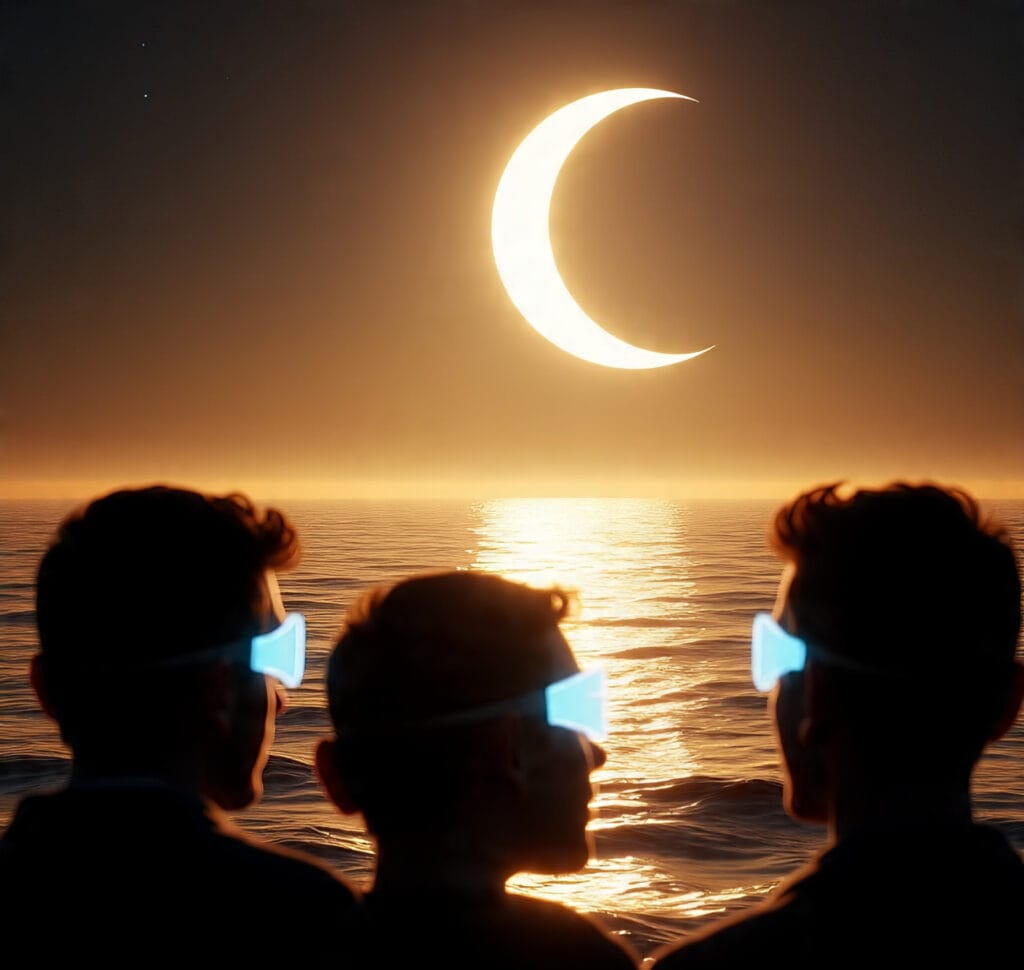
- Use certified solar eclipse glasses that meet the ISO 12312-2 standard. Regular sunglasses—no matter how dark—are not safe. NASA Science+1
- Solar filters designed for telescopes/binoculars, if you have them; make sure the filters are in good condition (no scratches, holes).
- Handheld solar viewers with certified filters work as well.
- If such equipment is not available, use indirect viewing methods, such as pinhole projection (makeshift viewer using paper/card) to project the Sun’s image onto a screen.
Steps for Safe Viewing
- Inspect the solar filter (glasses or viewer) for damage. Do not use if scratched, torn, or older than the manufacturer recommends.
- Put on the filter before looking at the sun; remove it only after you have turned away.
- Supervise children always.
- Never look at the sun through unfiltered cameras, telescopes, binoculars, or other optical devices, unless they are fitted with proper solar filters.
- Do not rely on homemade or improvised filters (e.g., smoked glass, CDs, regular sunglasses)—they are not safe.
Best Times for Regions (Local Examples)
Here are some local timings for selected regions to help you know when to start looking. Times are approximate, based on local time conversion from UTC. Always double-check with local astronomy or time-date services.
Region Approx. Local Start Time Approx. Local Maximum / Midpoint Approx. Local End Time New Zealand (Southern parts) Early morning on September 22, at sunrise (just after sunrise) Soon after sunrise, when coverage is highest Morning hours Eastern Australia coastline Very early morning (sunrise) Once the sun is above the horizon, partial coverage is visible.Morning, soon after sunrise, Pacific Islands Sunrise or early morning, depending on location, Mid-morning (just after peak) Morning hours
If you’re outside the visibility path, online livestreams (from reputable science or astronomy sites) are a good alternative to seeing the eclipse in real time. Space+1
Why This Eclipse Matters
- This is the final solar eclipse of 2025, closing the year’s cycle of solar-lunar events. Time and Date + 1
- It falls very close to the September equinox, which adds symbolic interest: days and nights are nearly equal around the world, and this eclipse reminds us of celestial rhythms. Space+1
- For regions where visibility is good, it offers stunning visuals and an educational opportunity: observing solar dynamics and understanding Earth-Moon-Sun alignments.
- Culturally, eclipses often carry mythological or ritual significance in different communities. Even in places where it is not visible, the event still sparks curiosity and online engagement.
Preparation Tips
To make the most of this solar eclipse, plan ahead:
- Check local visibility: Use astronomy apps or websites (TimeandDate, EarthSky, space agency pages) to see exact times and how much of the Sun will be obscured in your city.
- Acquire proper viewing gear early: Solar eclipse glasses can sell out or be delayed, so get them from trusted sources ahead of time.
- Scout a good location: Find open space with a clear view of the horizon (especially east if sunrise sighting). Avoid tall buildings or trees that can block the view.
- Check the weather forecast:Plan for cloud cover or haze. If the forecast is bad, identify a backup site if possible.
- Set reminders: The eclipse phases pass over hours; missing the start or maximum reduces the experience. Use local time conversions.
- Photography? Prepare: If photographing, use solar filters on the camera and avoid pointing sensitive equipment directly at the sun without protection. Know your camera settings ahead of time.
What Not to Do
- Do not look directly at the sun without certified protection at any time during the partial eclipse.
- Do not use regular sunglasses or tinted lenses that are not designed for eclipse viewing.
- Do not use cameras, binoculars, or telescopes without specialized solar filters—severe eye damage can result.
- Do not assume partial coverage is harmless—even a small sliver of sun without protection is dangerous.
Frequently Asked Questions
Will the eclipse be visible in India?
No. For most of India, this eclipse will not be visible. The eclipse path is in the Southern Hemisphere and does not cover India. The Times of India +1
What percentage of the Sun will be covered at peak for those in the visibility zones?
Around 80-85% in favorable zones (e.g., southern New Zealand, parts of Antarctica). In areas on the edge of the visibility path, coverage may be much less. EarthSky+1
Is there any time during this eclipse when looking at the Sun is safe without any protection?
No. Because this is a partial solar eclipse, at no point is the sun completely blocked. That means even at maximum coverage, there is always part of the sun shining, which can cause damage if viewed without protection. NASA Science+1
Can I view via livestream if it’s not visible where I am?
Yes. Many astronomy websites and science outlets will stream the eclipse live. This is the safest way to follow the event if you are outside the path or don’t have appropriate viewing gear. Space+1
Conclusion
The partial solar eclipse of September 21-22, 2025, is a beautiful reminder of the celestial mechanics at play between the Earth, Moon, and Sun. Even though it’s not visible everywhere, for those in the path—especially in New Zealand, the South Pacific, eastern Australia, and Antarctica—it promises dramatic views. Whether you’re an astronomy enthusiast or a curious observer, following the stages, preparing properly, and ensuring safe viewing can make this event memorable.
Mark your calendar, get your eclipse glasses ready, check visibility in your area, and don’t miss this natural wonder. Even if you can’t see it with your eyes, the eclipse is still unfolding somewhere on Earth, and you can join in virtually. Enjoy the show.
References
- EarthSky – A deep partial solar eclipse on September 21, 2025
🔗 https://earthsky.org/astronomy-essentials/a-deep-partial-solar-eclipse-september-21-2025 - Wikipedia – Solar eclipse of September 21, 2025
🔗 https://en.wikipedia.org/wiki/Solar_eclipse_of_September_21%2C_2025 - Time and Date – Solar and Lunar Eclipses Worldwide 2025
🔗 https://www.timeanddate.com/eclipse/2025 - Time and Date – Solar Eclipse September 21, 2025
🔗 https://www.timeanddate.com/eclipse/solar/2025-september-21 - NASA – Solar Eclipse Safety Guidelines
🔗 https://science.nasa.gov/eclipses/safety - Space.com – Don’t miss the partial solar eclipse today, Sept. 21, 2025
🔗 https://www.space.com/stargazing/solar-eclipses/dont-miss-the-partial-solar-eclipse-today-sept-21-2025-where-when-and-how-to-see-it - Sky at Night Magazine – Partial Solar Eclipse: 22 September 2025
🔗 https://www.skyatnightmagazine.com/news/partial-solar-eclipse-22-september-2025 - Times of India – Solar Eclipse 2025: Date, Sutak Kaal, and Visibility in India
🔗 https://timesofindia.indiatimes.com/astrology/planets-transits/surya-grahan-2025-solar-eclipse-date-sutak-kaal-in-india-and-visibility/articleshow/123995096.cms